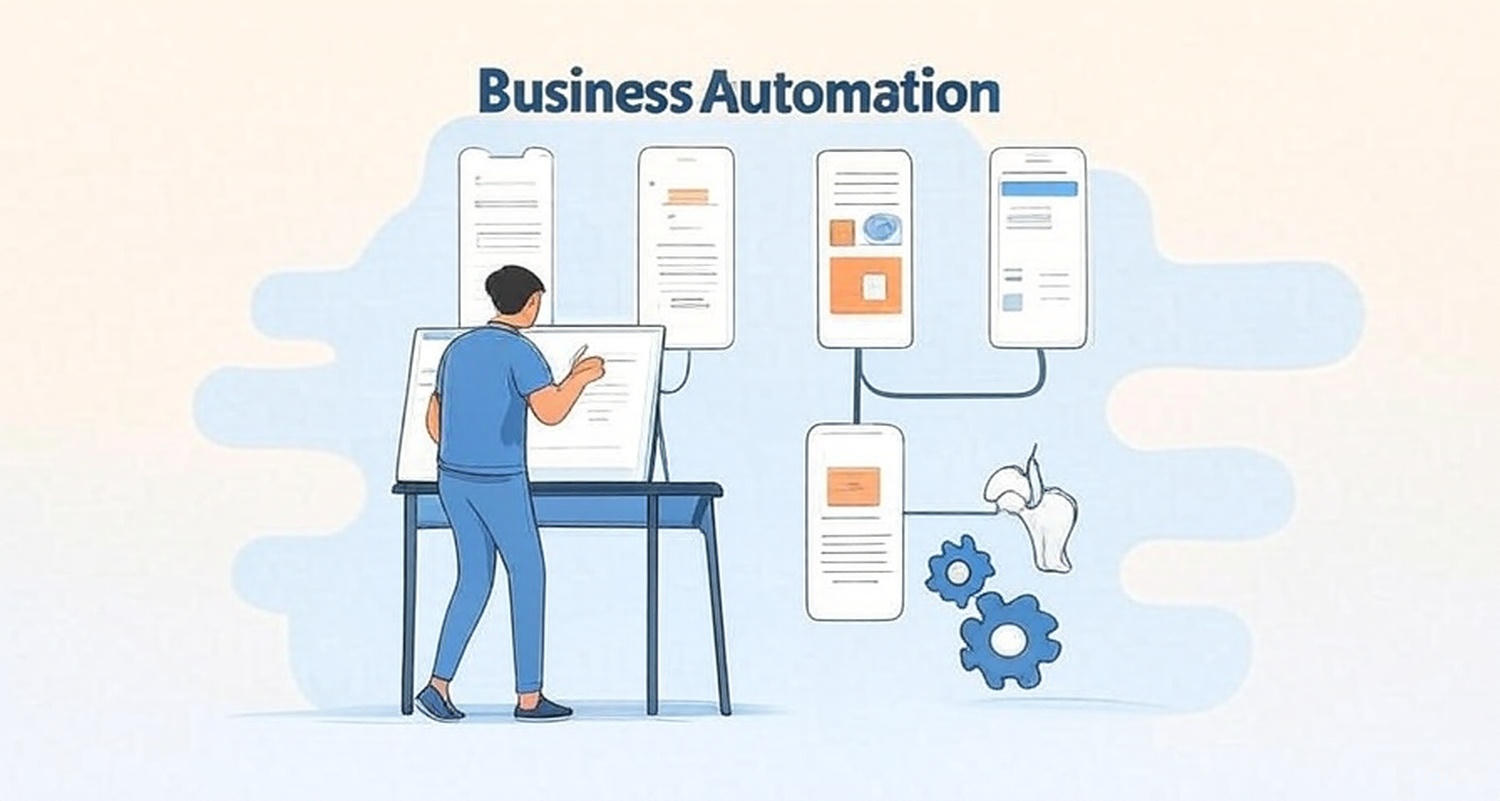
Websites for Humans vs. Website for Agents: Two Parallel Designs Every Engineering Team Must Master

Writen by
nguyen hoang khai
Who Is Your Website Actually Serving — Humans or AI Agents?
In 2025, a study across 3,000 websites found something worth thinking about: 63% of them had already received visits from AI agents — not from users sitting in front of a screen. Yet in that same period, only 24% of developers designed their APIs with AI agents in mind as a legitimate type of “user.” (Source: Postman State of the API Report 2025)
That 39-percentage-point gap is the real problem. And it’s widening.
If you’re a CTO or Engineering Lead planning your product roadmap for the next 12–18 months, the question “who does my website need to serve?” no longer has a single answer. Human users and AI agents read, interpret, and interact with websites in two fundamentally different ways — and your engineering team needs to accommodate both.

Humans and AI Agents “Read” Websites in Two Different Languages
This is the most important starting point: humans and AI agents process information on the web in two incompatible ways.
When a human user visits your pricing page, they scan the overall layout, compare plan tiers visually, click tooltips for clarification, and read testimonials at the bottom to reinforce their decision. This experience is guided by visual hierarchy, UX copy, and the overall feel of the page.
When an AI agent like OpenAI Operator or Perplexity accesses the same page, it doesn’t “see” anything. It queries structured data, parses HTML for semantic tags, calls your API if available, and makes decisions based on machine-readable data — not on how visually appealing your design is.
AI agents don’t browse the web. They query structured data, semantic layers, and APIs to find the fastest, most reliable answer to a user’s request.
Jakob Nielsen — widely considered the father of modern UX — called this shift the moment of “Goodbye UI Design.” His argument: when users no longer interact directly with an interface but instead delegate to an AI agent, the design target must change — from page flows and pixel decisions to outcomes, policies, and intent orchestration.
This isn’t a signal to abandon UX. It’s a signal to design two parallel layers.
Three Technical Differences Every Engineering Team Needs to Understand
1. Content vs. Structured Data
Human-facing websites focus on content — copywriting, visuals, narrative flow. Agent-facing websites focus on structured data: Schema.org markup, JSON-LD, OpenGraph tags, and increasingly important, llms.txt — a file that guides AI crawlers on how to access and prioritize content on your site.
The practical difference: a product page written well for human users can be completely “invisible” to an AI agent if it lacks properly formatted structured data. An agent won’t infer intent from your copywriting — it needs data that is explicit and machine-readable.
2. Navigation vs. API Endpoints
Humans navigate through menus, breadcrumbs, and internal links. AI agents bypass all of that navigation layer and find the shortest path to data — typically through REST APIs, GraphQL, or sitemaps.
Postman’s 2025 report noted that AI agents are becoming the fastest-growing segment of API consumers. But agents need APIs designed to a different standard — more explicit, less ambiguous, with clearer error handling than traditional developer-facing APIs. Unlike human developers who can read incomplete docs and adapt, agents need machine-readable schemas (OpenAPI 3.0+) and predictable response structures.
3. Trust Signals for Humans vs. Trust Signals for Machines
Humans evaluate trust through testimonials, badges, team photos, page load speed, and overall design. AI agents evaluate trust through the completeness of structured data, consistency of information across endpoints, freshness of content, and whether the domain has authority signals that machines can verify.
Gartner predicts that by 2026, 20% of customer interactions will be handled by AI agents rather than humans. At that scale, machine trust signals will matter as much as — and in some cases more than — human trust signals.
Why Optimizing for Only One Side Is a Strategic Risk
There’s a group of engineering teams optimizing their websites very well for human users while completely ignoring agent-readiness. These teams will run into problems as AI-powered buyer journeys become the norm — when users ask ChatGPT or Perplexity to recommend a vendor, and their product doesn’t appear in results because there’s no structured data for AI to parse.
The opposite group — focused on API and machine-readability but neglecting human UX — also has it wrong. Right now, AI agent traffic averages just 0.2% per website (February 2025 data). The majority of B2B buyer journeys still have direct touchpoints with real human users. Ignoring UX is a prioritization mistake.
The real problem is that these two types of websites require different design and testing mindsets — and most engineering teams haven’t yet built the processes to ensure quality for both.
A Decision Framework: Where Should You Invest, and in What Order?
There’s no “it depends” answer here. Below is a decision framework based on your product’s stage of development:
- Pre-PMF (under 1,000 users): Put 90% of effort into human UX. Agent-readiness is not a priority before you’ve validated product-market fit with real users. Risk: writing code too early for an audience that doesn’t exist yet.
- Post-PMF, scaling (1,000–50,000 users): Begin investing in structured data (Schema.org, JSON-LD), public API documentation following OpenAPI 3.0+, and
llms.txt. Suggested budget split: 70% human UX, 30% machine-readability. - Scale-up with enterprise buyers: Agent-readiness becomes a competitive moat. Enterprise buyers increasingly use AI tools to evaluate vendors — if your product doesn’t appear in AI-generated shortlists, you don’t exist in the deal. At this stage: 50/50.
- API-first product or B2D (developer tool): Invest 60–70% in machine-readability from the start. This is the audience where agents will replace workflows fastest.
Common Objections — and Why They’re Worth Revisiting
“AI agent traffic is currently too small to justify investment.”
True in terms of current numbers (0.2%). But this is the classic lagging indicator trap. Mobile web traffic was also tiny in 2008 — and teams that didn’t prepare had to rebuild everything under pressure. Agent adoption is following a similar trajectory, just faster.
“We already have structured data and APIs — what more is needed?”
Having an API doesn’t mean that API is agent-ready. Agents need predictable error handling, complete schemas, and no ambiguity in responses. Most existing APIs were designed for developers who read docs and adapt — not for agents operating fully autonomously. This gap requires its own audit.
Limitations of this framework: It doesn’t apply to safety-critical systems (fintech infrastructure, healthcare platforms) where AI agents are not permitted to make autonomous decisions. In those contexts, human UX and human oversight remain the absolute priority.
Practical Implications for Engineering Teams
If you’re at the post-PMF stage and haven’t addressed agent-readiness yet, here are 3 things you can start in your next sprint:
- Audit your current structured data: Use Google Rich Results Test and Schema Validator to see what your product is currently exposing to AI crawlers. Most teams are surprised by the gap between what they assumed and what’s actually there.
- Create a basic
llms.txtfile: This file guides AI crawlers on site structure and priority content. Not all LLM crawlers read it yet, but adoption is growing and the setup cost is low. - Review API documentation against OpenAPI 3.0+ standards: Ask yourself: if an AI agent needed to complete a task through your API without any human intervention, could it? Find places in your docs that require “common sense” to understand — those are the places where agents will fail.
More importantly: these changes need to be tested. Incorrect structured data is worse than no structured data at all — it can cause AI to cite wrong information about your product. Schema markup needs validation, API contracts need contract testing, and agent behavior when accessing your site needs to be tested with an agent simulator or headless browser before release.
Our View on Where the Industry Is Headed
The line between “website for humans” and “website for agents” won’t disappear — it will become more defined, not less. Over the next 2–3 years, the best products won’t be the ones that choose one or the other, but the ones that build two parallel experience layers: a human layer focused on narrative and trust, and a machine layer focused on accuracy and queryability.
Engineering teams that recognize this early — and build testing pipelines to ensure quality for both layers — will have a genuine advantage when AI-driven buyer journeys become the new standard. Not because they saw AI changing everything, but because they prepared before the numbers required them to.